
 购物车
购物车 
-
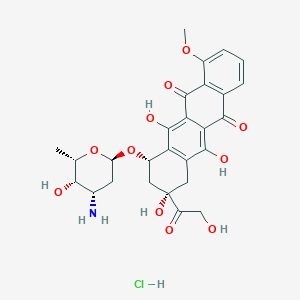
Doxorubicin hydrochloride
NMR and HPLC COA下载 MSDS下载 - Names:
Doxorubicin hydrochloride, Topoisomerase II inhibitor
- CAS号:
25316-40-9
MDL Number: MFCD00077757 - MF(分子式): C27H29NO11·HCl MW(分子量): 579.98
- EINECS:246-818-3 Reaxys Number:
- Pubchem ID: Brand:BIOFOUNT
| 货品编码 | 规格 | 纯度 | 价格 (¥) | 现价(¥) | 特价(¥) | 库存描述 | 数量 | 总计 (¥) |
|---|---|---|---|---|---|---|---|---|
| YZM000516-100mg | 100mg | 99.4% | ¥ 1620.00 | ¥ 1620.00 | 1-3天 | ¥ 0.00 | ||
| YZM000516-50mg | 50mg | 99.4% | ¥ 878.00 | ¥ 878.00 | 1-3天 | ¥ 0.00 |
| 中文别名 | 盐酸阿霉素(25316-40-9,Doxorubicin hydrochloride);阿霉素盐酸盐;盐酸阿霉素羟基柔红霉素盐酸盐 |
| 英文别名 | Doxorubicin hydrochloride(25316-40-9);Doxorubicin HCl;Adriblastina;Doxorubicin (Adriamycin) HCl |
| CAS号 | 25316-40-9 |
| Inchi | InChI=1S/C27H29NO11.ClH/c1-10-22(31)13(28)6-17(38-10)39-15-8-27(36,16(30)9-29)7-12-19(15)26(35)21-20(24(12)33)23(32)11-4-3-5-14(37-2)18(11)25(21)34;/h3-5,10,13,15,17,22,29,31,33,35-36H,6-9,28H2,1-2H3;1H/t10-,13-,15-,17-,22+,27-;/m0./s1 |
| InchiKey | MWWSFMDVAYGXBV-RUELKSSGSA-N |
| 分子式 Molecular Weight | C27H29NO11·HCl |
| 分子量 Formula | 579.98 |
| 溶解度Solubility | DMSO : 50 mg/mL (86.21 mM; Need ultrasonic) H2O : 33.33 mg/mL (57.47 mM; Need ultrasonic) |
| 性状 | 红色到橙色固体粉末 |
| 储藏条件 Storage conditions | 4°C,避光 |
一、分子水平
1.核心靶点与抑制活性(IC50KiEC??)
TopoII(拓扑异构酶II)抑制IC50:2.67μM(人源重组酶)
TopoI(拓扑异构酶I)抑制IC50:0.8μM(人源重组酶)
DNA嵌入效应EC??:0.2–0.8μM(DNA链断裂/γ H2AX)
Ki:非经典可逆抑制,以“DNA嵌入+TopoII毒剂(poison)”为主,不适用单纯Ki描述
KD(SPR/MST):与双链DNA结合KD≈10–50nM(极强亲和力)
2.选择性(Selectivity)
无激酶靶点选择性:广谱细胞毒,对增殖期细胞杀伤远强于静息细胞
同源靶点交叉:同时抑制TopoI/II,无明显亚型选择性
3.抑制模式(Modeofinhibition)
DNA嵌入(Intercalation):蒽环平面插入DNA碱基对,扭曲双螺旋、阻断复制转录
TopoII毒剂作用:稳定TopoII DNA切割复合物,导致不可逆双链断裂(DSB)
氧化应激(ROS):醌环还原循环产生活性氧,直接损伤DNA与线粒体
4.热位移(Tm)与结合验证
DNA DOX复合物Tm升高5–12℃,证明强嵌入结合
分子对接晶体结构:嵌入DNA大沟,与碱基形成氢键与疏水作用
| 细胞系 | GI50 |
| MCF-7(乳腺癌) | 0.69μM |
| BT474(乳腺癌) | 1.14μM |
| HepG2(肝癌) | 0.05–0.5μM |
| HCT116(结肠癌) | 0.1–0.5μM |
| MCF 7/ADR(耐药) | >10μM |
| 16HBE(正常支气管) | 0.18μM |
DNA损伤:↑γ H2AX(DSB标志物)、↑p p53、↑p ATM/ATR
凋亡通路:↑cleaved caspase 3/9、↑Bax/Bcl 2比值、↓抗凋亡蛋白
周期阻滞:↓CDK1/cyclinB1,诱导G2/M阻滞
增殖抑制:↓p AKT、↓p ERK、↓胸苷尿苷掺入
3.细胞表型
增殖:克隆形成率显著下降(IC??浓度下几乎完全抑制)
凋亡:AnnexinV阳性率剂量依赖性升高(0.5μM,16h>30%)
周期:G2/M期细胞比例从15%升至60–80%(1μM,24h)
迁移侵袭:Transwell划痕实验显示迁移率下降>50%
4.耐药与协同(CI)
主要耐药机制:P gp高表达(外排泵)、MRP过表达、DNA修复增强、TopoII下调
协同组合(CI<1):
与顺铂卡铂联用:CI≈0.3–0.6
与紫杉醇多西他赛联用:CI≈0.4–0.7
与PD 1/PD L1抑制剂联用:增强免疫原性细胞死亡(ICD)
5.透膜性与胞内富集
透膜:中等亲脂性(LogP≈1.2–1.5),易跨膜、核富集
P gp底物:强外排,是多药耐药(MDR)核心原因
胞内浓度:核内浓度>胞质5–10倍
三、成药性
LogP:1.2–1.5(中等亲脂)
pKa:多基团(酚羟基、氨基),盐酸盐水溶性极佳(水:100mg/mL)
稳定性:光不稳定、pH敏感(酸性稳定,碱性易降解)、易氧化
纯度杂质:临床要求纯度>99%,严控蒽环类降解物与异构体
2.ADME核心
(1)溶解度
热力学溶解度:水>10mg/mL(注射级);口服溶出差(pH依赖)
动力学溶解度:DMSO中100mg/mL(172mM)
(2)透膜(Caco 2PAMPA)
PAMPA:中等渗透性(Papp≈1–5×10??cm/s)
Caco 2:P gp强底物,外排率>5,口服生物利用度<5%
(3)代谢(肝微粒体)
代谢酶:CYP3A4、CYP2D6、醛酮还原酶(AKR)、P gp底物
主要代谢物:多柔比星醇(Doxorubicinol)(活性代谢物,心脏毒性增强)
肝微粒体t?/?:30–60min(中等代谢稳定性)
CLint:中等清除,非CYP主导(还原共轭代谢为主)
(4)血浆蛋白结合率(PPB)
70–80%(白蛋白为主,浓度非依赖)
(5)CYP抑制诱导(DDI)
CYP3A4/2D6中等抑制,无强诱导;DDI风险中等
(6)稳定性
光稳定性:极差,需避光操作储存
pH稳定性:pH4–6稳定,pH>7快速降解
四、体内药理&药效
1.动物PK参数(小鼠大鼠,iv)
※三相半衰期:
α相(分布):5–10min
β相(快速清除):2–3h
γ相(终末):20–48h国家药品监督管理局
Cmax:推注后即刻达峰(10mg/kg,Cmax≈10–20μM)
AUC:剂量依赖,无明显饱和(30–70mg/m²)
生物利用度(F):<5%(几乎无口服价值)
※组织分布:
高富集:肝、脾、肾、心脏、肿瘤
低无:血脑屏障不可透过
心脏蓄积:心脏浓度>血药5–10倍(毒性根源)
2.体内药效(荷瘤小鼠)
抑瘤率(TGI):5–10mg/kg,iv,q3d×3,TGI60–90%(MCF 7、HepG2、CT26)
肿瘤生长延迟:较对照组延长10–20天
生存期:中位生存期延长50–100%
剂量 效应:明显,治疗窗窄(有效剂量接近毒性剂量)
五、毒理性
1.心脏毒性(最严重,剂量限制性)
机制:ROS损伤心肌线粒体、铁离子催化自由基、心肌细胞凋亡铁死亡
累积剂量限制:人**≤550mg/m²**(>450mg/m²心衰风险显著升高)
发生率:
300mg/m²:1–2%
400mg/m²:3–5%
450mg/m²:5–8%
550mg/m²:6–20%
hERG:强抑制(IC??≈1–5μM),QT间期延长风险高
2.骨髓抑制(急性剂量限制性)
中性粒细胞减少:IV后7–14天达谷,重度抑制(<500/mm³)常见
血小板贫血:中度,恢复较快(21–28天)
3.遗传毒性
Ames试验阳性,强致突变致癌性(DNA损伤机制)
4.其他毒性
局部毒性:外渗致严重组织坏死(vesicant级别)
溶血免疫原性:溶血低,免疫原性弱(小分子特征)
肝肾毒性:肝代谢为主,胆汁淤积风险;肾毒性轻
盐酸阿霉素(25316-40-9,Doxorubicin hydrochloride)实验注意事项:
1.实验前需戴好防护眼镜,穿戴防护服和口罩,佩戴手套,避免与皮肤接触。
2.实验过程中如遇到有毒或者刺激性物质及有害物质产生,必要时实验操作需要手套箱内完成以免对实验人员造成伤害。
3.取样品的移液枪头需及时更换,必要时为避免交叉污染尽可能选择滤芯吸头。
4.称量药品时选用称量纸,并无风处取药和称量以免扬撒,试剂的容器使用前务必确保干净,并消毒。
5.取药品时尽量采用多个药勺分别使用,使用后清洗干净后,烘干消毒存放。
6.实验后产生的废弃物需分类存储,并交于专业生物废气物处理公司处理,以免造成环境污染。
Doxorubicin hydrochloride(25316-40-9) Experimental considerations:
1. Wear protective glasses, protective clothing and masks, gloves, and avoid contact with the skin during the experiment.
2. The waste generated after the experiment needs to be stored separately, and handed over to a professional biological waste gas treatment company to avoid environmental pollution.
Tag:盐酸阿霉素(25316-40-9,Doxorubicin hydrochloride),盐酸阿霉素试剂,盐酸阿霉素的作用,阿霉素盐酸盐,盐酸阿霉素的价格,盐酸阿霉素的纯度,盐酸阿霉素的厂家,盐酸阿霉素的外观,盐酸阿霉素的溶解度,盐酸阿霉素的使用注意事项,盐酸阿霉素的杂质,盐酸阿霉素的MSDS,盐酸阿霉素的储存条件
| 产品说明 | 盐酸阿霉素(25316-40-9,Doxorubicin hydrochloride)仅做科学研究实验使用,盐酸阿霉素MSDS,盐酸阿霉素溶解度见主页。 |
| Introduction | Doxorubicin hydrochloride (25316-40-9,盐酸阿霉素) is only used for scientific research and chemical synthesis intermediates. Please see the homepage for other parameters of 25316-40-9 |
| Application1 | 盐酸阿霉素是一种DNA嵌入剂和强大的细胞毒剂。 |
| Application2 | 抗肿瘤抗生素,在心脏线粒体DNA方面有阿霉素的效果 |
| Application3 | 反相转录酶和RNA聚合酶的抑制剂,免疫抑制剂;可插入DNA链中 |
| 警示图 | |
| 危险性 | warning |
| 危险性警示 | No data available |
| 安全声明 | H302,H350 |
| 安全防护 | P201,P308+P313 |
| 备注 | 实验过程中防止吸入、食入,做好安全防护 |
| 象形图 |   |
|---|---|
| 信号 | Danger |
| GHS危险说明 |
Aggregated GHS information provided by 153 companies from 21 notifications to the ECHA C&L Inventory. Each notification may be associated with multiple companies. H302 (77.12%): Harmful if swallowed [Warning Acute toxicity, oral] H315 (27.45%): Causes skin irritation [Warning Skin corrosion/irritation] H319 (32.03%): Causes serious eye irritation [Warning Serious eye damage/eye irritation] H340 (33.99%): May cause genetic defects [Danger Germ cell mutagenicity] H350 (92.81%): May cause cancer [Danger Carcinogenicity] H360 (31.37%): May damage fertility or the unborn child [Danger Reproductive toxicity] Information may vary between notifications depending on impurities, additives, and other factors. The percentage value in parenthesis indicates the notified classification ratio from companies that provide hazard codes. Only hazard codes with percentage values above 10% are shown. |
| 防范说明代码 |
P201, P202, P264, P270, P280, P281, P301+P312, P302+P352, P305+P351+P338, P308+P313, P321, P330, P332+P313, P337+P313, P362, P405, and P501 (The corresponding statement to each P-code can be found at the GHS Classification page.) |
| Pharmacology of Doxorubicin (Pharmacology Mentor, 2026) – 机制与临床综述 |
| 2. New potential therapy for orthotopic bladder carcinoma by combining HVJ envelope with doxorubicin(Cancer Chemotherapy and Pharmacology,2007) |
| 3. Hollow gold nanoshells-incorporated injectable genetically engineered hydrogel for sustained chemo-photothermal therapy of tumor(Journal of Nanobiotechnology,2019) |
| 4. Targeted cancer therapy based on single-wall carbon nanohorns with doxorubicin in vitro and in vivo(Journal of Nanoparticle Research,2014) |
| 5. A New Polymer–Lipid Hybrid Nanoparticle System Increases Cytotoxicity of Doxorubicin Against Multidrug-Resistant Human Breast Cancer Cells(Pharmaceutical Research,2006) |
1.Electrochemical Behavior and Square Wave Voltammetric Determination of Doxorubicin Hydrochloride
Younghee Hahn and Ho Young Lee. Arch Pharm Res Vol 27, No 1, 31-34, 2004
The detecting system connected to CE was a carbon disk working electrode with an applied potential of 0.95 V vs. a Ag/AgCI (3 M KCI), which measured anodic currents due to the oxidation of two phenolic hydroxyls in the aglycone of daunorubicin (Hu et aL, 2000). Meanwhile, reductive detecting system measured at -0.30 V was preferred to oxidation in which the chromatographic profile suffered severe interference from substances that result from the biological matrix (Ricciarello et aL, 1998). Electrochemical assay often offers selectivity and sensitivity due to the selective detection of electroactive species among the complex samples. The chemical structure of doxorubicin contains a electrochemically a reducible quinone moiety in the aglycone which prompted us to study its electro-chemical behavior by using mercury electrodes, followed by developing the fast and sensitive square wave voltammetric (SWV) procedure for the determination of doxorubicin hydrochloride in the present study.
2.Facile fabrication of thermally responsive Pluronic F127-based nanocapsules for controlled release of doxorubicin hydrochloride
Zhipeng Zeng & Zhiping Peng & Lei Chen & Yiwang Chen. Colloid Polym Sci (2014) 292:1521–1530
The short cross-linking reaction time led to the formation of nanocapsules with thin and low-cross-linked PL shell because the cross-linking reaction between the –NPC groups and –NH2 groups was slow. The difference of the contrast between the PL shell and the hollow core resulted in the typical empty core–shell structure which can be found in the TEM images. After reacting for 20 h, the diameter of the nanocapsules increased to about 200 nm as shown in Fig. 2b. Assuming that the size change of the inner cavity was negligible, the thickness of the PL shell can be estimated to be more than 60 nm. The denser and tighter (with high cross-linking density for long reaction time) PL shell resulted in the empty core–shell structure invisible in the TEM image even though the hollow inner cavity was still there. For the Pluronic F127/HA nanocapsules as shown in Fig. 2d, the smaller and instable nanocapsules were formed because of the slower reaction rate between –COOH groups and –NH2 groups. After reacting for 20 h, the diameter of the Pluronic F127/HA nanocapsules was determined to be about 220 nm. The size of the Pluronic F127/HA nanocapsules was larger than the Pluronic F127/PL nanocapsules because the content of HA was more than PL taken up by the nanocapsules. The average size was consistent with those determined from DLS results.
3.A Method for Evaluation of Therapeutic Dose of Doxorubicin Hydrochloride Using Breast Tumor Cell Culture MCF-7
Ya. D. Shanskij, Yu. A. Ershov*, and V. M. Pechennikov*. Bulletin of Experimental Biology and Medicine, Vol. 148, No. 3, 2009
Statistical data suggest that the use of anticancer drug does not signi? cantly increase the total survival of patient. This is largely associated with dif?culties in rational regimen of drug usage. The choice of the dose of anticancer drugs is mainly empirical. This is also true for doxorubicin hydrochloride, antitumor antibiotic of the anthracycline family used for breast cancer management.
- 相关产品
-
< >
- 推荐产品
-
< >
- 最新产品
-
< >
新闻
怎么做细胞爬片免疫组化染色实验
细胞爬片免疫组化染色,是通过细胞爬片是让玻片浸在细胞培养基内,细胞在玻片上生长,主要用于组织学,免疫组织化学...
2020/7/20 22:04:33
提取病毒RNA的实验方法
提取病毒RNA方法分别有:异硫氰酸胍的提取病毒RNA方法、TRIzol LS提取法、Trizol法提取法等等...
2020/7/22 20:29:26
细胞培养耗材技术领先性
细胞培养板行业面临的核心痛点是:常规TC处理后表面亲水角随时间衰减,影响长期培养稳定性,BIOFOUNT高分...
2026/4/28 15:12:51
细胞培养耗材关键性能
细胞培养板的水接触角作为表面润湿性的核心指标,直接影响细胞贴壁、增殖、分化及功能表达,其中40°(低接触角/...
2026/4/28 14:52:44
chelex 100树脂国产替代之路-BIOFOUNT范德生物
Chelex 100螯合离子交换树脂对铜、铁和其他重金属?的偏好显著高于对钠、钾等一价阳离子的偏好。它对二价...
2025/11/4 14:22:46
9月开学季——助研新学期 范德送好礼
2025/8/28 15:30:55

Waxfilm 实验室封口膜:技术与国际市场的双重突破
在实验室耗材领域,封口膜是保障实验准确性与稳定性的关键产品之一。近年来,Waxfilm?实验室封口膜凭借其卓...
2025/5/13 13:03:40
Waxfilm实验室封口膜的5大突破
Waxfilm实验室封口膜作为生物功能膜领域的国产技术突破和品牌突破,是生物领域中国技术发展的缩影。
2025/5/6 17:02:07
各种微流控芯片键合方法的优缺点
微流控芯片键合:目前主要有激光焊接、热压键合、胶键合、超音波焊接,每种方法都有各自的优缺点。本文主要介绍聚酯...
2023/7/28 10:43:09
新一代微流控键合解决方案
微流控键合解决方案:微流控芯片制造的一个重要环节,也是最容易被忽视的--芯片键合。其中一个重要因素是:微流控...
2023/7/27 12:44:28